
Last updated: October 2026
By Amarpreet Bhui • Last updated: 2026-07-05
What this guide covers
Building a custom home involves two projects at once: constructing the property and managing the financing that keeps each stage moving. A regular purchase mortgage is usually designed to fund a completed home at closing, while construction financing is designed around a project that has not yet reached completion.
This guide explains how a custom home construction loan can work for borrowers in Mississauga and elsewhere in Southern Ontario. It covers the documents lenders commonly review, how progress draws and inspections fit together, which alternatives may suit an addition or renovation, and how to prepare for the mortgage that follows construction.
The exact structure, approval conditions, draw timing, interest rate, fees, and required equity depend on the lender, the property, the borrower, and the project documents. A broker can compare available options, but the lender’s written commitment controls the transaction.
What is a custom home construction loan?
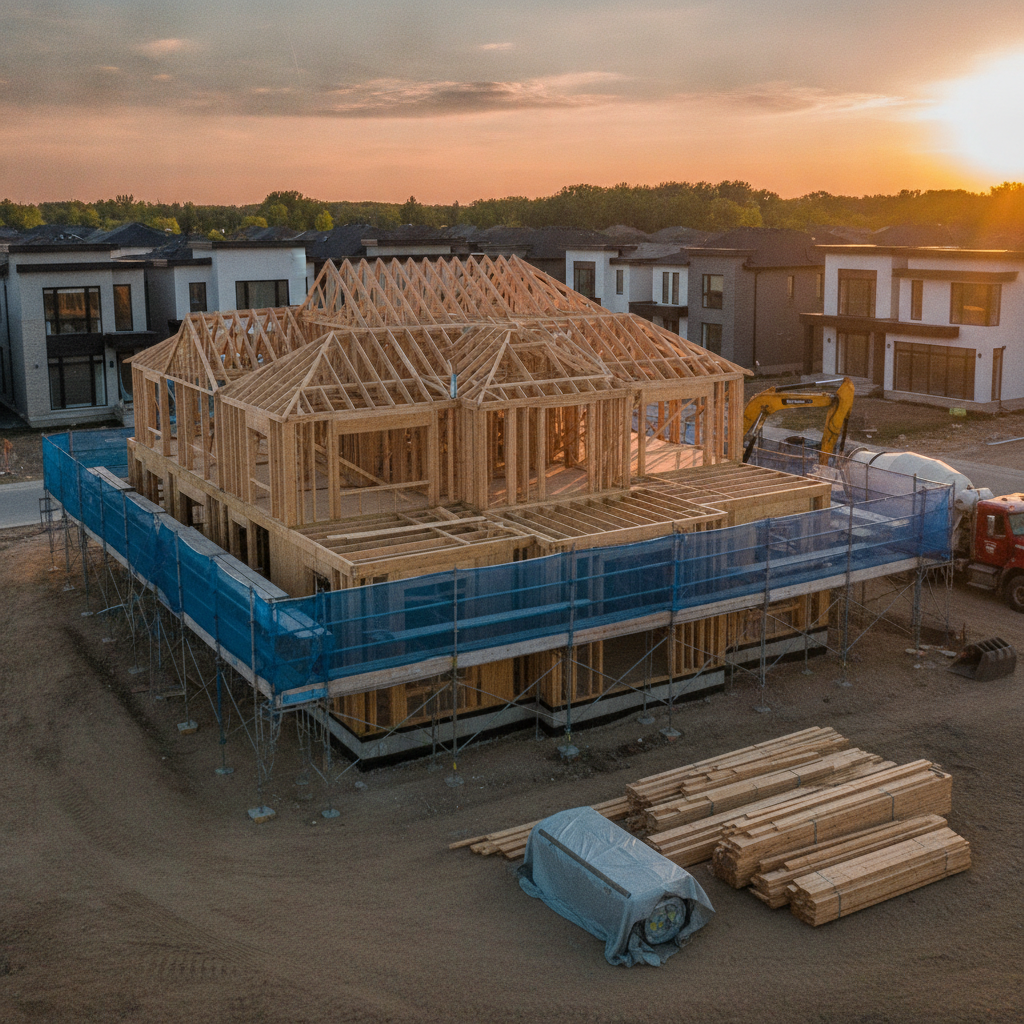
A custom home construction loan is financing arranged for a ground-up build, with funds released as defined stages of work are completed. Instead of receiving the full facility on the first day, the borrower requests advances according to a draw schedule supported by inspections, invoices, photographs, or other lender requirements.
Construction financing commonly has two phases. The first is the building period, when the borrower uses staged advances to pay eligible project costs. The second is the exit or conversion phase, when the completed property supports a regular amortizing mortgage, a construction-to-permanent conversion, or a refinance with another lender.
- Project term: The facility is set for an agreed construction period, with any extension subject to lender approval.
- Progress draws: Advances are linked to milestones such as foundation, framing, lock-up, interior work, and completion.
- Interest during construction: Depending on the facility, interest is calculated on the amount advanced rather than the full approved limit.
- Inspections and holdbacks: The lender may verify progress and retain amounts required by the loan agreement or applicable requirements.
- Exit financing: The borrower must have a clear plan for the long-term mortgage before the construction facility matures.
These features make construction financing different from simply drawing on available credit. The lender is evaluating both the borrower and the proposed finished property, including its budget, plans, specifications, market value, and execution risk.
Why construction financing matters for a custom build
A custom build creates cash-flow pressure because trades, suppliers, permits, deposits, and inspections do not all occur on the same day. Financing that follows the work can reduce the need to pay for the entire project from savings or unsecured credit before the property has value as a completed home.
Staged funding also creates a review process. Draw requests encourage the borrower, builder, inspector, and lender to agree on what has been completed and what is expected next. That does not eliminate construction risk, but it can make missing documentation, cost changes, or schedule problems visible earlier.
When a construction loan is usually a better fit
- You are building a new home on a serviced or serviceable lot.
- The project has plans, specifications, a credible budget, and a defined builder or construction plan.
- The amount required is too large or too structured for ordinary savings and revolving credit.
- You need financing to match construction milestones instead of receiving all funds at purchase closing.
- You can demonstrate how the facility will be repaid or converted once the home is complete.
When another financing option may be more suitable
A smaller addition or renovation may be manageable through a home equity line of credit, savings, or a renovation product, depending on available equity and the lender’s rules. A HELOC in Ontario can provide flexible access to funds, but it may not provide the milestone controls, inspection process, or project-specific structure required for a ground-up build.
Do not assume that an approved home-equity limit equals a construction budget. A lender may assess borrowing capacity, property value, debt-service obligations, and the proposed work separately.
How the custom home construction loan process works
The process begins well before the first draw. The strongest applications connect the borrower’s financial profile to a complete project file, then show how the draw schedule, contingency, and long-term mortgage work together.
1. Establish the land, project, and budget
Start by confirming whether the land is already owned, will be purchased, or has existing financing. Gather the legal description, purchase agreement or title information, servicing details, zoning information, and any known site constraints.
Next, build a budget that separates land, demolition or site work, permits, design, labour, materials, utilities, taxes, professional fees, financing costs, and landscaping. Include a contingency that reflects the project’s complexity rather than treating the first estimate as a guaranteed final cost.
Preliminary plans and a detailed builder estimate are more useful than a single total. They help the lender understand what is included, what is an allowance, and where a cost increase could create a funding gap.
2. Review affordability and eligibility
Before committing to a builder or major non-refundable deposit, review income, credit history, existing debts, down payment or land equity, and the expected completed value. Self-employed borrowers may need additional documentation to explain business income, retained earnings, or fluctuations between tax years.
An affordability review should include both construction-period carrying costs and the expected payment after conversion. A payment that works only while the facility is interest-only may not be sustainable once the full mortgage is amortizing.
3. Prepare the lender application
A construction application commonly includes identification, income verification, credit authorization, asset and liability information, land documents, plans, specifications, a construction contract or builder information, a detailed budget, and a proposed draw schedule. The lender may also request an appraisal based on the projected completed property.
Ontario borrowers should understand the role of the mortgage professional and the information being requested. The Financial Services Regulatory Authority of Ontario explains the mortgage application process, including the importance of working with a licensed mortgage brokerage, broker, or agent.
Use consistent file names and keep the budget, plans, specifications, and contract version-controlled. If the lender sees different totals in different documents, underwriting may pause while the discrepancy is resolved.
4. Review approval conditions and close
An approval is not the same as unrestricted access to funds. Read the lender’s written commitment and identify conditions relating to appraisal, title, insurance, permits, builder information, equity, inspections, legal work, and the first advance.
Before closing, confirm who requests each draw, which invoices or photos are required, how inspections are booked, what holdbacks apply, and how long an advance normally takes after approval. A short written process shared with the builder can prevent avoidable delays.
5. Request draws as milestones are completed
Each draw should correspond to the agreed schedule, not simply to an urgent bill. The borrower or builder submits the required request, documents, and evidence of progress; the lender or its inspector reviews the stage; and the approved amount is advanced subject to the facility terms.
Milestones vary, but a schedule may include land or initial site work, foundation, framing, lock-up, mechanical and interior rough-ins, drywall and finishes, and final completion. Some lenders use fewer or more stages. The commitment should be treated as the controlling document rather than assuming every lender uses the same sequence.
Keep a draw tracker with the requested date, milestone, amount, supporting documents, inspection date, outstanding conditions, and funded date. This makes it easier to identify whether a delay is caused by incomplete work, missing paperwork, inspection availability, or lender processing.
6. Complete the home and arrange the exit
Near completion, confirm the lender’s requirements for the final inspection, occupancy documentation, permits, insurance, invoices, and release of any remaining funds or holdbacks. Do not wait until the keys are ready to discuss the long-term mortgage.
If the facility converts automatically, confirm the conversion date, rate terms, amortization, payment schedule, and any conditions. If a refinance is required, allow time for updated income documents, a new appraisal, lender review, legal work, and rate planning.
How draws, inspections, and holdbacks affect cash flow
Progress draws are the central operating feature of a custom home construction loan. They are intended to release money in proportion to completed work, which means a builder may need to manage deposits and short-term timing between milestones.
Plan the draw schedule around real work
Ask the builder to identify the work that must be paid before each milestone and the lead times for materials such as windows, HVAC equipment, cabinetry, and specialty finishes. A draw that arrives after a supplier deadline may be technically correct but still create a project delay.
At the same time, avoid requesting a draw for work that is not complete. A mismatch between the request and the inspection can lead to a reduced advance, a second inspection, or a funding gap that the borrower must cover temporarily.
Understand interest and unused funds
Many construction structures calculate interest on advanced funds during the build, but the precise payment method and rate are lender-specific. Ask whether interest is paid monthly, added to the facility, or handled through another arrangement, and confirm how the lender treats fees and advances.
Model at least three cash-flow points: the early stage when little has been drawn, the middle of construction when the balance may be much higher, and the completed-home mortgage payment. This gives a more realistic picture than using only the initial payment.
Allow for holdbacks and timing gaps
A holdback means part of an otherwise approved amount remains unpaid until specified conditions are satisfied. The reason may relate to construction completion, inspection results, lien-related requirements, or the lender’s contract terms. Build the possibility of a delayed portion into the contingency rather than treating every approved dollar as immediately available.

Construction loan, standard mortgage, or HELOC?
The right structure depends on the work, the amount required, available equity, and the certainty of the repayment plan. The following comparison is a starting point, not a substitute for reviewing a lender’s specific terms.
| Feature | Custom construction loan | Standard mortgage | HELOC |
|---|---|---|---|
| Typical use | Ground-up custom home | Completed home purchase or refinance | Addition, renovation, or flexible equity access |
| Funding pattern | Progress draws tied to milestones | Usually advanced at closing | Borrower draws as needed within the approved limit |
| Project oversight | May include inspections, appraisals, and holdbacks | Generally focused on the completed property | Usually less project-specific oversight |
| Interest basis | Often based on funds advanced during construction | Based on the mortgage balance | Based on the revolving balance and product terms |
| Long-term outcome | Conversion or refinance after completion | Already functions as long-term financing | May remain revolving or be refinanced |
A HELOC can be useful for a defined addition where the borrower has sufficient equity and the lender accepts the scope. For a new custom home, a formal construction facility generally gives the project a clearer budget, draw process, and completion plan.
What lenders assess and what to prepare
Lenders assess the borrower, the land, the project, and the exit strategy together. A strong income profile cannot compensate for an incomplete budget, and an attractive projected value does not remove the need to show repayment capacity.
Borrower information
- Employment or business income documentation and current identification.
- Credit history, existing debts, monthly obligations, and assets.
- Proof of down payment, land equity, or other funds available for the project.
- Details of any co-borrower, guarantor, or ownership arrangement.
Project information
- Land title or purchase documents, zoning details, and servicing information.
- Plans, specifications, site information, and a realistic construction timeline.
- Detailed budget with allowances, professional fees, taxes, and contingency.
- Builder contract, experience, references, insurance, and licensing information where applicable.
- Proposed draw schedule and the evidence expected at each stage.
For a new home in Ontario, confirm the builder’s regulatory position and documentation. The Home Construction Regulatory Authority regulates new home builders and vendors in Ontario and provides access to the Ontario Builder Directory. A builder review is not a replacement for the lender’s underwriting, but it is an important diligence step.
Exit information
Explain how the completed home will be financed. The lender may consider the projected completed value, the borrower’s future payment, occupancy plans, and whether the original facility is designed to convert. If the plan is to refinance, understand that future approval is not guaranteed merely because the construction loan was approved.
How to budget for the build and the mortgage
A construction budget should distinguish fixed costs from allowances and identify costs that are easy to overlook. Site conditions, utility connections, design changes, landscaping, temporary accommodation, storage, legal fees, appraisal charges, inspection costs, and financing expenses can all affect the amount of cash required.
Use a contingency deliberately
A contingency is not spare money for upgrades chosen after construction begins. It is a reserve for unknown site conditions, price changes, rework, weather-related timing, and necessary changes. The appropriate amount depends on the project and lender requirements; do not present a generic percentage as a guaranteed rule.
Separate construction and household cash flow
Keep a clear record of which costs are included in the construction facility and which must be paid personally. Maintain enough liquidity for household expenses, rent or existing mortgage payments, taxes, insurance, deposits, and periods when an inspection or draw takes longer than expected.
Stress-test the completed payment
Review the expected mortgage payment using the proposed balance, amortization, and a range of possible rates. Also consider property taxes, home insurance, utilities, maintenance, and any remaining debt. The goal is to ensure the completed home remains affordable after construction-period financing ends.
Mississauga and Southern Ontario planning considerations
Mississauga projects can involve teardown work, infill constraints, servicing questions, neighbour coordination, and limited space for material storage. A schedule that works on a large suburban lot may not work on a tight urban site where deliveries, demolition, and inspections must be coordinated carefully.
Weather also affects sequencing. Winter and early-spring conditions can complicate excavation, concrete, exterior enclosure, and site access. Build reasonable schedule float into the plan and ask the builder how weather delays affect the next draw milestone.
Permit and inspection timing should be treated as a project dependency rather than an administrative afterthought. Keep copies of submissions, approvals, inspection results, and open items so the lender and construction team are working from the same information.

Common risks and ways to reduce them
Underestimating the complete project cost
A low initial estimate can make a project appear affordable while excluding professional fees, taxes, site work, appliances, landscaping, or financing costs. Use a line-by-line budget and obtain clarification in writing whenever the builder’s price includes an allowance.
Changing the scope without changing the funding plan
Upgraded windows, larger finishes, layout changes, and added rooms can consume contingency quickly. Use signed change orders that show the added cost, schedule effect, and funding source before authorizing work.
Assuming every draw will be funded immediately
Inspection availability, incomplete documentation, holdbacks, and work that does not match the agreed milestone can affect timing. Ask for the process in advance and keep a short-term reserve for ordinary timing gaps.
Choosing a builder on price alone
The lowest estimate may not represent the lowest total cost if it omits work or relies on unrealistic allowances. Compare scope, schedule, payment terms, insurance, experience, references, and the builder’s ability to provide the documents required by the lender.
Ignoring fraud and approval documentation
Borrowers should review the lender’s official written approval and conditions, not rely on informal assurances. FSRA’s guidance on watching out for mortgage fraud explains why borrowers should be cautious about misrepresentation, altered documents, and requests that do not match the formal transaction.
How a mortgage broker can help
A mortgage broker can help organize the borrower and project information, identify lenders that consider construction financing, compare the broad structure of available options, and coordinate questions between the borrower, lender, lawyer, appraiser, and builder. The broker does not replace the builder, lawyer, inspector, or municipal authority.
Ask what services are included, how compensation works, which lenders or products may be considered, and what information is needed to assess the file. FSRA’s guidance on working with a mortgage professional explains the role of licensed professionals and the questions consumers should ask.
For a Mississauga borrower, local familiarity can also help with practical coordination, but no broker can guarantee approval, a specific rate, a draw date, or the final appraised value. Those outcomes depend on the lender and the evidence in the application.
A practical pre-application checklist
- Confirm the land ownership or purchase plan and identify existing financing.
- Collect current income, asset, liability, and credit information.
- Obtain plans, specifications, builder details, and a detailed project budget.
- Separate fixed costs, allowances, taxes, professional fees, and contingency.
- Draft a milestone-based draw schedule with supporting evidence for each stage.
- Estimate interest during construction and the payment after conversion.
- Ask the lender about inspections, holdbacks, legal work, insurance, and extensions.
- Confirm the exit plan before construction begins.
- Keep all versions of contracts, invoices, permits, photos, and inspection records.
This preparation does not guarantee approval, but it makes the project easier to evaluate. It also gives you a clearer basis for comparing a construction mortgage with a standard mortgage, HELOC, or another financing approach.
Frequently asked questions
How does a custom home construction loan differ from a regular mortgage?
A regular mortgage commonly funds a completed property at purchase or refinance closing. A custom home construction loan releases financing through progress draws as the home is built, then requires conversion or separate long-term financing when construction is complete.
How many draws are used for a custom home build?
The number varies by lender and project, but a schedule commonly uses several milestones such as foundation, framing, lock-up, interior work, and completion. The written commitment determines the actual number, evidence, inspection process, and timing.
Can a self-employed borrower qualify for construction financing?
Self-employed borrowers may qualify when they can document income, creditworthiness, available equity, and a viable project. Lenders may request business financial statements, tax documents, contracts, and explanations for income changes, so early document preparation is valuable.
Can I use a HELOC instead of a construction loan?
A HELOC may be suitable for a smaller addition or renovation where available equity and the project scope fit the lender’s requirements. A ground-up custom home usually needs a more structured facility with staged advances, inspections, and a defined completion plan.
Conclusion
A custom home construction loan is most effective when the financing plan is developed alongside the plans, budget, builder contract, and construction schedule. Staged draws can align borrowing with progress, but the borrower still needs contingency funds, complete documentation, realistic timing, and a clear long-term mortgage strategy.
For a Mississauga or Southern Ontario build, review the land, project, borrower, and exit plan together before committing to construction. A structured application gives lenders better evidence and gives you a clearer view of the cash required from the first site visit through the completed mortgage.
Plan your custom build financing
Amarpreet Bhui can help you organize the financing questions, documents, draw assumptions, and long-term mortgage plan for your project. Start with MiiGrowth to discuss your custom home construction loan options.
Last updated November 4, 2026